
Female Pattern Hair Loss Can Start in Your 20s or Around Menopause
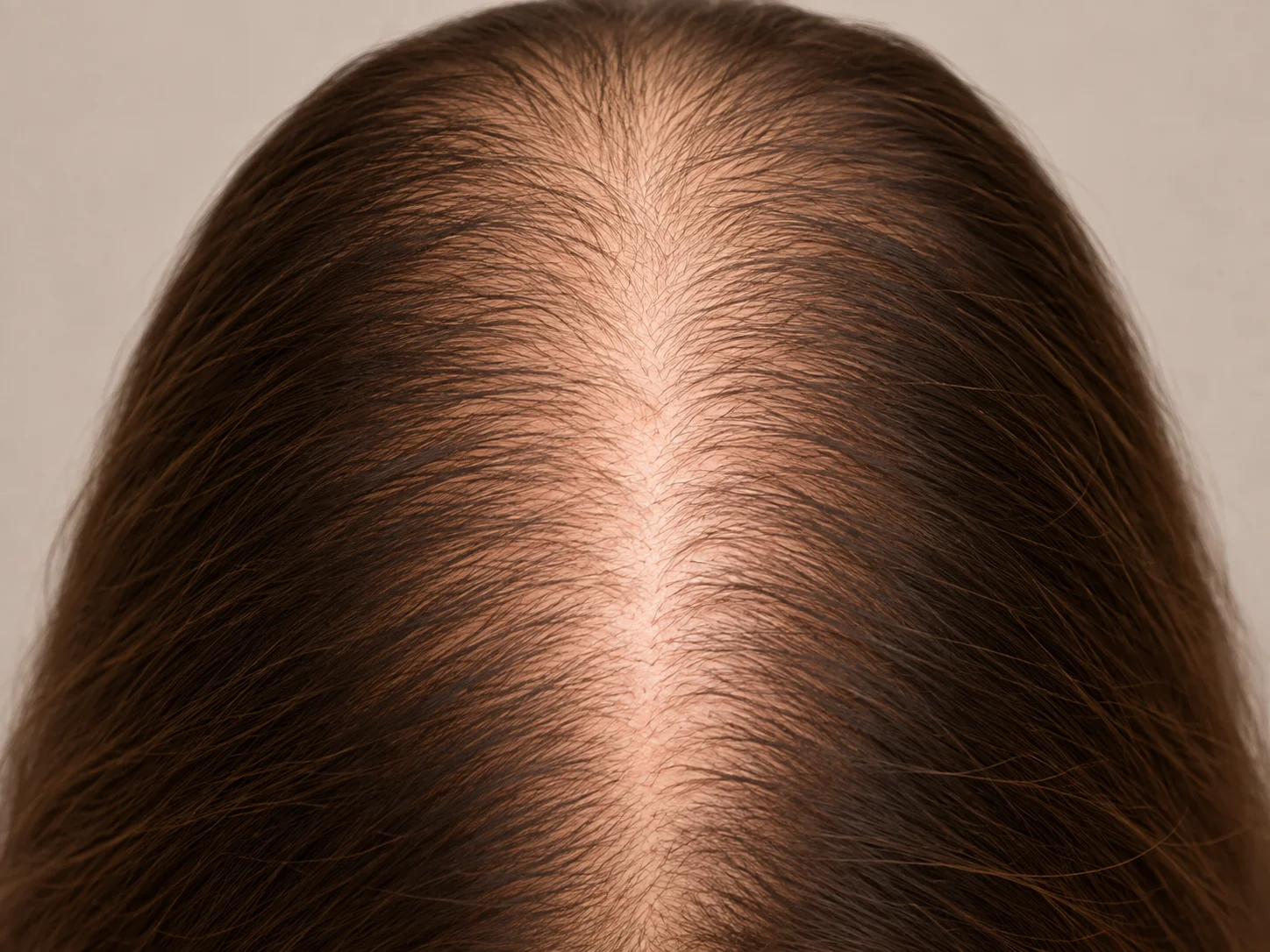
Hair thinning in women gets treated as one condition with one cause, something that shows up "at menopause." The biology is less tidy than that. Female pattern hair loss runs on two different timelines, and only one of them has anything to do with menopause at all.
About 40% of women show this pattern of diffuse thinning, most visible along the part line and at the crown rather than at the hairline, by the time they reach 70.1 The medical name is female pattern hair loss, and it can show up as early as your twenties or cluster decades later, around the menopausal transition. Dermatology treats early-onset and late-onset cases as genuinely distinct conditions, not an early and a late version of the same story.2 Genetics plays a role in both. What differs is which other biology is in play.
What follicle miniaturization looks like
Each hair grows from a cycle of active growth followed by rest. In female pattern hair loss, that cycle does not stop so much as shrink: the active growth phase gets shorter with each turn, and the follicle producing the hair gets narrower along with it. A hair that once grew thick and long for years starts growing finer and for less time, cycle after cycle, until what comes in is short, fine, and barely pigmented instead of a full terminal hair.1 Genetics sets who is susceptible to this pattern in the first place, which is why family history remains the single strongest predictor.
In men, the same process is tied tightly to one signal: dihydrotestosterone, a potent byproduct of testosterone acting on genetically sensitive follicles. In women, that link is real but looser, and the direct role of androgen signaling in female pattern hair loss is still an open question in the research, not a settled one.1
The timeline that tracks menopause
The later-onset pattern commonly presents around the menopausal transition itself, the stretch of hormonal change surrounding a person's final period, rather than reliably before it or reliably after.2 A shift in the ratio between estrogen and androgen signaling is the mechanism most often proposed: estrogen may ordinarily buffer androgen-sensitive follicles, and its decline could remove some of that buffer. But dedicated reviews of menopause and hair are candid that this is a proposed mechanism, not a settled one. The role of estrogen and androgens in female pattern hair loss is still described as unclear, and there is not yet enough evidence to say hormone therapy changes the course of the condition.2 What is well documented is the pattern itself, thinning that clusters around the menopausal transition. What is still being worked out is the mechanism underneath it.
The one lab value worth checking
Genetics and hormone timing are not things you can change. One measurable factor is: iron. Low ferritin, the protein that stores iron, is associated with hair shedding and thinning in women even before it drops low enough to cause anemia, and correcting a genuine deficiency is one of the few interventions here with a clear before-and-after.3 It is not a cause on the scale of genetics or hormones, but it is the rare lever that is both testable and fixable.
What you can do
Genetics and the hormone shift itself are not something you can change directly, but two things around them are worth knowing, and one is worth ruling out. The only topical ingredient with placebo-controlled trial evidence in women specifically is minoxidil: a head-to-head trial comparing two strengths found measurable, if modest, regrowth in both groups.4 Separately, ask for a ferritin test rather than assuming it is fine. A genuine deficiency is correctable, and correcting it is one of the few moves here with a clean before-and-after.3 Caffeine applied directly to the scalp has laboratory support and a small clinical trial in women showing good tolerability and cosmetic benefit, a plausible complement rather than a stand-alone fix.1 None of this changes the biology in the first section. It gives you two things to check and one to ask a dermatologist about, instead of one thing to watch in the mirror.
References
- Völker JM, Koch N, Becker M, Klenk A. Caffeine and Its Pharmacological Benefits in the Management of Androgenetic Alopecia: A Review. Skin Pharmacology and Physiology. 2020;33:153-169. DOI: 10.1159/000508228
- Kamp E, Ashraf M, Musbahi E, DeGiovanni C. Menopause, skin and common dermatoses. Part 1: hair disorders. Clinical and Experimental Dermatology. 2022;47(12):2110-2116. DOI: 10.1111/ced.15327
- Rushton DH. Nutritional factors and hair loss. Clinical and Experimental Dermatology. 2002;27(5):396-404. DOI: 10.1046/j.1365-2230.2002.01076.x
- Blume-Peytavi U, Hillmann K, Dietz E, Canfield D, Garcia Bartels N. A randomized, single-blind trial of 5% minoxidil foam once daily versus 2% minoxidil solution twice daily in the treatment of androgenetic alopecia in women. Journal of the American Academy of Dermatology. 2011;65(6):1126-1134. DOI: 10.1016/j.jaad.2010.09.724