
How Caffeine, Rosemary, Rice Bran and Tyrosine Impact Hair Follicles
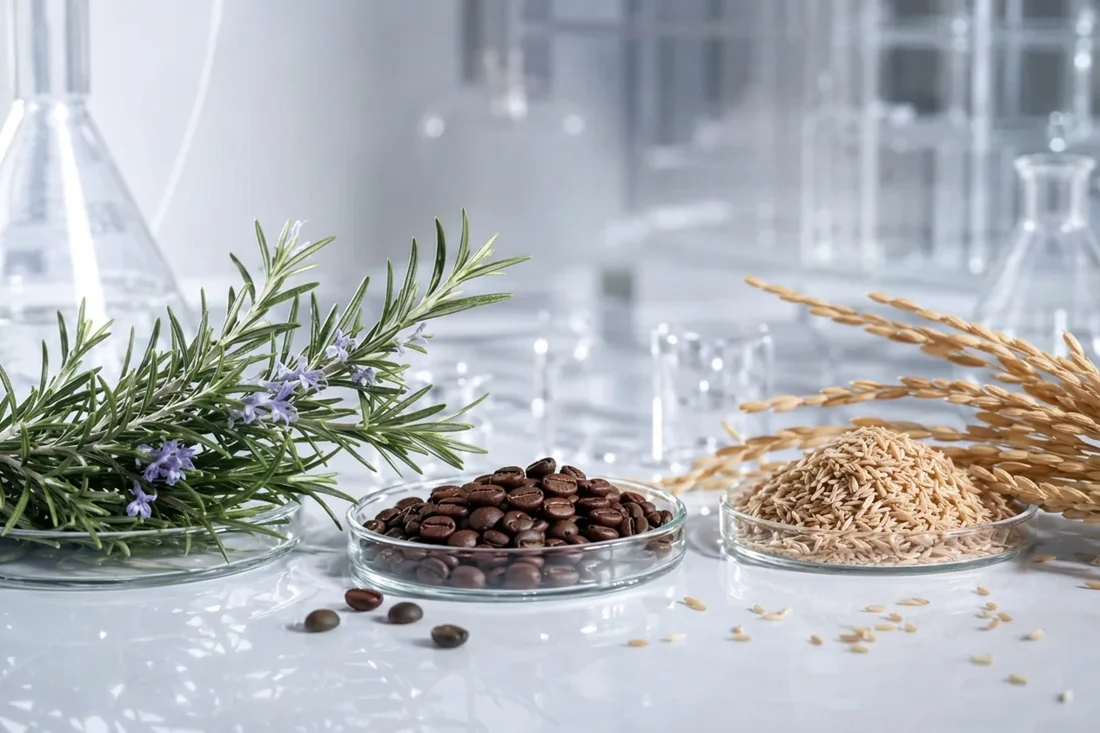
Haircare relies on a variety of ingredients, some more reputable than others. The useful ones have a biological mechanism that can be seen working in follicles. Here is what the research shows for five common ones, including two that reach into color.
Caffeine: keeping the growth phase going
Each follicle cycles between a growth phase, anagen, and a resting phase - and the longer it stays in anagen, the longer and thicker the strand. Testosterone shortens that phase in people prone to pattern hair loss. In lab-grown human follicles, caffeine counteracts the slowing and pushes the follicles to grow longer shafts. The catch is delivery: a cup of coffee will not reach the follicle; a scalp formulation can.
Rosemary: protecting the environment, and the color
Rosemary’s best-studied compounds, carnosic and ursolic acid, are antioxidants and anti-inflammatories, and a calmer scalp is a better place for a follicle to cycle. In a six-month trial, rosemary oil performed about as well as minoxidil for pattern hair loss, with less itching. On color, oxidative damage is a well-documented contributor to graying, so an antioxidant is plausibly working on the right target. One survey found rosemary-oil users had less graying - though a survey shows association, not cause.
Rice bran: a nudge toward the growth signal
At the base of each follicle, the dermal papilla tells it when to grow. Treated with rice-bran mineral extract in the lab, human dermal papilla cells raise their growth-phase signals, including the Wnt pathway, and turn down inflammation. This is isolated-cell evidence, not a human trial, but it points at a mechanism rather than a vague promise.
Tyrosine: purely about color
Melanin is built by pigment cells through a chain of steps, and the first step is the enzyme tyrosinase acting on the amino acid tyrosine. Tyrosine is the raw material color is made from. Whether adding more increases pigment is not established, because in a healthy follicle it is rarely the limiting factor. It is on the label as a building block, not a growth stimulant.
Vitamins: cofactors, not magic
When someone is low in iron or vitamin D, correcting it can help - and those are worth checking with a clinician. For people who are not deficient, the evidence that extra biotin or vitamin E does anything is weak. Think of them as cofactors: they matter when one is missing and do little when the tank is full.
The point
An ingredient is only as good as the job it does once it reaches the follicle. Caffeine and rice bran act on growth, tyrosine supplies color’s raw material, rosemary helps protect it, and the rest support the conditions. Specificity is the difference between a formula and a wish.
References
- Fischer TW, Hipler UC, Elsner P. Effect of caffeine and testosterone on the proliferation of human hair follicles in vitro. International Journal of Dermatology. 2007;46(1):27-35. DOI: 10.1111/j.1365-4632.2007.03119.x
- de Macedo LM, Santos ÉMD, Militão L, Tundisi LL, Ataide JA, Souto EB, Mazzola PG. Rosemary (Rosmarinus officinalis L., syn Salvia rosmarinus Spenn.) and Its Topical Applications: A Review. Plants. 2020;9(5):651. DOI: 10.3390/plants9050651
- Panahi Y, Taghizadeh M, Marzony ET, Sahebkar A. Rosemary oil vs minoxidil 2% for the treatment of androgenetic alopecia: a randomized comparative trial. Skinmed. 2015;13(1):15-21. PMID: 25842469
- Seiberg M. Age-induced hair greying: the multiple effects of oxidative stress. International Journal of Cosmetic Science. 2013;35(6):532-538. DOI: 10.1111/ics.12090
- Aldhafiri HJ, Alshalhoob H, Alshreef SM, et al. Hair greying associated with rosemary use: a cross-sectional study in Saudi Arabia. Dermatology Reports. 2025. DOI: 10.4081/dr.2025.10126
- Kim YM, Kwon SJ, Jang HJ, Seo YK. Rice bran mineral extract increases the expression of anagen-related molecules in human dermal papilla through wnt/catenin pathway. Food & Nutrition Research. 2017;61(1):1412792. DOI: 10.1080/16546628.2017.1412792
- Fernandes B, Cavaco-Paulo A, Matamá T. A Comprehensive Review of Mammalian Pigmentation: Paving the Way for Innovative Hair Colour-Changing Cosmetics. Biology. 2023;12(2):290. DOI: 10.3390/biology12020290
- Almohanna HM, Ahmed AA, Tsatalis JP, Tosti A. The Role of Vitamins and Minerals in Hair Loss: A Review. Dermatology and Therapy. 2019;9(1):51-70. DOI: 10.1007/s13555-018-0278-6